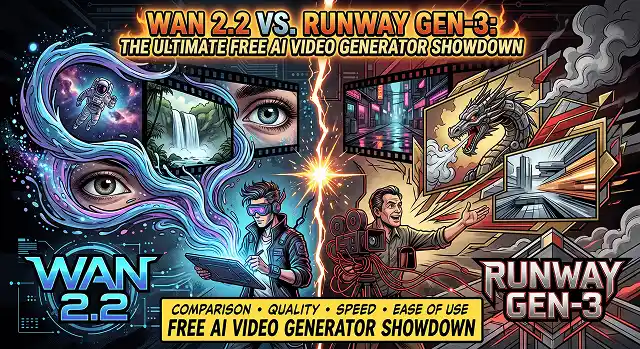
The technology behind video generation has developed extremely fast, and has changed from unclear video snippets into high-end, Hollywood video. Today, two prominent players are involved in shaping the industry: Wan 2.2 of Alibaba, and Runway Gen-3 Alpha.
Runway Gen-3 introduced several industry standards regarding vectors of video production and consistency over time, however, the unprecedented introduction of Wan 2.2 with its Mixture-of-Experts technology has triggered a real revolution in the industry, providing an opportunity to create videos of studio quality at an affordable price.
In the recommendations below you will find a detailed comparison of the effectiveness, camera movements, consistency of physics, speed of rendering, and cost of translation for the purposes of choosing the right engine for video production.
Above-the-Fold Breakdown: Wan 2.2 vs. Runway Gen-3
AI Video Generation Benchmarks · Open-Source Architecture vs. Proprietary Cloud
| Comparison Metric | Wan 2.2 (Open-Source Architecture) | Runway Gen-3 Alpha (Proprietary Cloud) |
|---|---|---|
| Model Type / Access | Open-Source (MoE Architecture) & Native Cloud Utilities | Proprietary Closed SaaS Cloud Platform |
| Native Render Resolutions | 480p, 580p, 720p (Upscalable to 4K via web tools) | 720p, 1080p HD |
| Clip Duration Per Render | 5 – 6 Seconds (Extendable via multi-scene workflows) | 5 or 10 Seconds |
| Camera & Director Controls | Pan, Tilt, Zoom, Tracking, and Dolly movements | Motion Brush, Camera Control Vectors, Keyframing |
| Physics & Motion Coherence | Very High: Accurate object interactions and reduced morphing | High: Smooth human motion and cinematic physics |
| Pricing & Cost Barrier | 100% Free locally or via no-watermark creator platforms | Credit-based (Paid subscription tiers required) |
1. Authenticity of Visuals and Realistic Rendering
Photorealism, when it comes to the creation of scenes, relies entirely on how well light, skin textures, and depth of space are conveyed by the model at hand.
- Runway Gen-3 Alpha : This tool ensures that the cinematographic lighting is precise and atmospheric. It excels at slow-motion portraits, ambient environmental smoke, and dramatic camera pushes. However, heavy text prompts can occasionally result in waxy skin textures or overly smooth surfaces.
- Wan 2.2 : This model incorporates a unique denoising method with two experts, where one focuses on the overall design of the scene, whereas the second one is dealing with finer details. Hence, Wan 2.2 produces textures, which look natural, and skin porosity and provides accurate illumination of the surroundings.
Winner: Tie. Runway Gen-3 delivers a pre-stylized Hollywood feel out of the box, while Wan 2.2 offers higher texture accuracy and cleaner raw details.
2. Complex Motion, Camera Vectors, & Real-World Physics
"Flow shift" is one of the most common problems in AI video production when things alter, body parts clip through other items of clothing, or hands twist while being in motion or doing an action.
- Runway Gen-3 : Allows controlling interface by actions such as through Motion Brushes which let users draw on some part of still image to move it (for example, move water in stationary positions like a bridge).
- Wan 2.2 : Trained on various sets of datasets, Wan 2.2 does well in the realistic modeling of different physical processes like cloth movements, fluids behavior, and human walking patterns. This algorithm is very good at performing a camera shot and has no problem with getting distorted images in movement.
- 1. Text prompt: "Cinematic camera shot showing a runner hurrying down a neon street while the camera moves low."
- 2. Wan 2.2 Physics Engine: This system can create the water splashes in the right way in accordance with the foot impacts but ensures that the street is reflected in the same position.
- 3. Text prompt: Output Coherence: High temporal consistency across all 24 frames per second without limb distortion.
Winner: Wan 2.2. Its Mixture-of-Experts (MoE) design processes structural motion and fine detail pass-by-pass, reducing AI morphing errors.
3. Generation Speed & Operational Cost
The cost of production is key for independent filmmakers, digital marketers and content developers.
1. Evaluate Runway Gen-3 Cost Structure
- Runway operates on a credit-based subscription model. Generating a single 10-second clip consumes substantial credit value. Iterating on complex prompts or running multiple test variations can quickly become expensive.
2. Evaluate Wan 2.2 Cost Structure
- Wan 2.2 is an open source model that can run on the user’s hardware (such as the RTX 4090) or through an online service. This helps avoid high subscription costs on a per-clip basis, making it highly suited for heavy rendering.
Winner: Wan 2.2. Its open-source nature allows creators to iterate freely without per-generation credit restrictions.
Deep Technical & Parameter Benchmarking
Model Architecture Benchmarks · Hardware & Inference Performance Matrix
| Technical Feature / Metric | Wan 2.2 (Open-Source Mixture-of-Experts) | Runway Gen-3 Alpha (Proprietary Cloud) |
|---|---|---|
| Model Parameter Scale | 14B Total Parameters (4B Active per token via MoE) | Undisclosed (Estimated Multi-Billion Dense Model) |
| VRAM Requirement (Local) | 8GB – 12GB VRAM (Quantized) / 24GB (FP16 Native) | N/A (Runs exclusively on cloud server clusters) |
| Frame Generation Speed | ~30 to 60 Seconds (Cloud-accelerated web tools) | ~45 to 90 Seconds (Varies with cloud queue traffic) |
| Motion Continuity & FPS | Native 24fps output with stable temporal anchors | Native 24fps / 30fps output |
| Image-to-Video Flexibility | High: Exceptional adherence to face anchors & line art | High: Strong style transfer with precise keyframing |
| Negative Prompting Support | Yes (Supported natively in open-source UI) | No (Controlled via style sliders and positive prompts) |
| Commercial License | 100% Free for Commercial Use (Apache 2.0 / Open) | Paid Subscription Required for Commercial Rights |
Request A Custom AI Video
Tell us what you're trying to create and we'll point you to the right tool — or help you set it up.
Under the Hood: Inside the Mixture-of-Experts (MoE) Framework in Video Generation
The primary breakthrough enabling Wan 2.2 to match and exceed closed-source models like Runway Gen-3 lies in its Mixture-of-Experts (MoE) Diffusion Transformer (DiT) architecture.
Traditional video models pass every single pixel through a massive, uniform neural network. This creates a computational bottleneck: processing high-resolution background elements uses the exact same compute power as calculating intricate facial physics or hands.
How Wan 2.2's MoE Model Operates:
- Dynamic Token Routing: When you enter a prompt, a sparse gating network splits the video latent space into specialized mathematical tasks.
- Layout & Motion Expert: Dedicated parameter blocks handle global composition, camera trajectory (dolly, pan, tilt), and large-scale lighting changes across time steps.
- Micro-Detail Expert: Independent parameter sets focus strictly on high-frequency noise removal—refining individual hair strands, water reflections, and fabric weave patterns.
By activating only a fraction of its total parameter weights per frame, Wan 2.2 achieves faster inference speeds and lower VRAM consumption while dramatically reducing the "waxy face" and "melting limb" artifacts common in dense models.
Masterclass Prompting: Camera Vectors & Physics Directing
Because Wan 2.2 is trained on cinematic video datasets, using standard descriptive adjectives (like "ultra-detailed, 8K, trending on ArtStation") often degrades the render quality. To unlock true Hollywood motion consistency, structure your prompts using explicit camera parameters and lighting vectors.
A 4-Part Cinematic Prompt Structure:
[Subject + Action] + [Camera Movement + Lens Details] + [Lighting] + [Color / Film]
1. Realistic Sci-Fi Tracking Scene
- Prompt: Female astronaut walks through dusty red Martian canyon in old weathered dusty space suit Low angle tracking dolly moving back, eye-level, 35mm anamorphic 2.4:1, shallow dof Harsh directional golden hour light creating dust rays volumetrically, orange and teal color grade, subtle film grain.
2. Sweat-inducing Activity/Automobiles
- Prompt: A classic black muscle vehicle gliding through a dark town corner with rain-soaked roads. Shooting via a quick-moving camera close to the ground and shaped like a flat country 24mm wide-angle lens. Neon pink and blue reflections on the wet earth illuminated in the chiaroscuro style with brilliant contrast between light and dark elements and an obvious blurring of the rims of the wheels.
3. Character Close-Up & Emotion
- Prompt: Close-up view of an elderly craftsman gazing at a glowing pocket watch mechanism. Still macro image taken using a microcamera system, using an 85 mm fixed focal length lens, aperture f1.8. Candlelight providing warm light and revealing the person’s skin texture, while deep shadows appear and provide a feeling of nostalgic film effect. No artificial smoothing.
Wan 2.2 vs Runway Gen-3 Showdown
Compare open-source compute flexibility against enterprise cloud physics, free tiers, and generation models.
It comes down to closed cloud software versus open model architecture. Runway Gen-3 is a proprietary enterprise engine hosted entirely on closed cloud infrastructure with strict safety filters and paywalls. Wan 2.2 is an open-weights video foundation model (developed by Alibaba) that can be run locally via workflows like ComfyUI or accessed through open web interfaces, giving creators full control over LoRAs, fine-tuning, and generation speed without recurring subscription costs.
Wan 2.2 offers far superior free access. Runway Gen-3 limits non-paying accounts to a one-time trial credit pool that runs out after generating just a few short clips. Because Wan 2.2 is an open-source architecture hosted on public hubs (like Hugging Face Spaces, Replicate demos, and local setups), creators can generate unwatermarked, high-resolution clips continuously without hitting paywalls.
Both models excel at real-world physics, but in different ways. Runway Gen-3 excels at hyper-realistic human micro-expressions, lip alignment, and cinematic camera moves (such as orbit zooms or crane shots). Wan 2.2 excels at complex environmental interactions—rendering heavy volumetric smoke, liquid splatters, cloth physics, and multi-object collision dynamics with exceptional spatial consistency.
Runway Gen-3 runs entirely in the cloud, requiring zero local processing power—you can render 4K clips from a basic laptop or tablet browser. To run Wan 2.2 locally at full precision, your desktop setup requires an NVIDIA GPU with at least 12GB to 16GB of dedicated VRAM (such as an RTX 4070 or better). If your GPU is under these specs, you can still use quantized versions of Wan 2.2 or run it on cloud spaces like Hugging Face.
Runway Gen-3 offers a polished out-of-the-box UI suite, complete with Motion Brushes, Camera Control sliders, and Director Mode keyframing. However, when Wan 2.2 is integrated into ComfyUI or ControlNet pipelines, it far exceeds Runway's capabilities. It allows node-based keyframing, trajectory masking, custom LoRA blending, and precise depth-map tracking for advanced workflows.
Runway Gen-3 responds best to structured film director prompts containing optical terminology (e.g., "35mm lens, F/1.8 aperture, FPV drone pan"). Wan 2.2 uses a flexible natural-language transformer interface that understands detailed, multi-sentence scene layouts without needing heavy technical jargon. Both models deliver their best visual consistency when anchored by a starting image (Image-to-Video).
Choose Runway Gen-3 if you need a quick, web-based tool for commercial video editing, actor lip-syncing, and polished cinematic camera control. Choose Wan 2.2 if you want a zero-cost, watermark-free generator with open-source flexibility, deep physics simulation, custom LoRA support, and no subscription limits.
Ready to try AI Videos?
Transform your ideas into cinematic video in seconds.