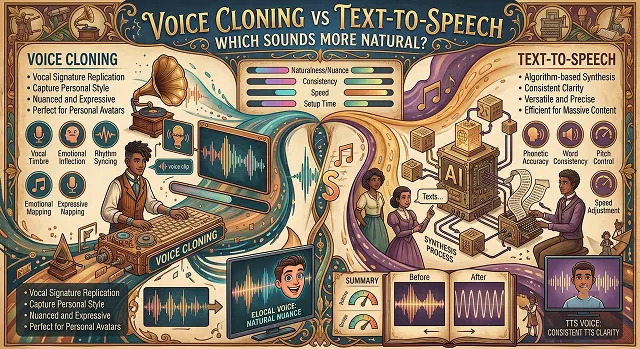
The debate on the use of synthetic audio has advanced beyond that of mere machine readability. Instead, the primary objective has become creating something so convincing that the listener will not realize he/she is listening to a machine.
In the creation of conversational applications on the web, creating an automated video studio or even interactive customer care systems, two major techniques emerge: Voice Cloning and Text-to-Speech (TTS).
Both these techniques convert the written word into an audio file, but the architecture used by each is completely different from one another.
1. The Core Architectural Difference
In order to determine which system sounds more natural, you have to know how each piece of technology transforms natural language tokens into sound waves:
[Standard Text-to-Speech] ➔ Text Tokens ➔ Fixed Neural Model (Acoustic + Vocoder) ➔ Stock Library Voice
[AI Voice Cloning] ➔ Text Tokens + Human Audio Reference ➔ Cross-Attention Denoising ➔ Replicated Identity Voice
Standard Text-to-Speech (TTS)
- Traditional and modern neural TTS systems use a pre-trained, fixed library model. A team of data scientists records hours of speech from a professional voice actor in a studio, structures the dataset, and builds a dedicated static model profile.
- When the system processes text, it translates those strings into standard pronunciation blocks based exclusively on its locked library.
- The Result: The output is extremely clear and predictable, but it can sound slightly generic or overly polished.
AI Voice Cloning
- Voice Cloning is an identity replication model. It does not rely on using pre-trained voices from a stock library; instead, an autoregressive transformer or flow-matching diffusion network gets input in the form of a brief audio clip (just 3-10 seconds long for a zero-shot voice clone) and gets an acoustic signature.
- What it does is it looks at the exact microscopic traits of that particular voice, including breathing patterns, regional accent, vocal fry, raspy voice, and pitch changes.
- The Result: The voice clone will sound entirely human, just like the original one.
2. When to Choose Voice Cloning
Voice cloning wins when personal branding, emotional range, and unique human flaws are critical to your user experience.
Top Production Scenarios:
- Real-Time Interactive Avatars: For use in automated customer service assistants or NPCs in games through natural dialogues. The use of the voice clone of someone who is a top performer and locked to the identity makes the user feel like he is conversing with his peer and not a machine.
- Multilingual Localization & Dubbing: Localization and dubbing of videos and audio portfolios into different languages around the globe and still retaining the voice identity of the creator in all places.
- Voice Banking for Accessibility: Giving patients with degenerative voice disorders the opportunity of recording a few seconds of their voice for use in communication applications.
- The Cloning Verdict: Voice cloning seems more natural when used in conversational narration, character voices, and relationship media.
3. When to Choose Text-to-Speech
Use text-to-speech when high accuracy, speed, and company professionalism matter more than individual character.
Top Production Scenarios:
- Automated Corporate Training: Engineering dense, multi-hour technical explainers, dashboard tutorials, or software documentation walkthroughs where clear, steady narration matters most.
- Mass Notification & IVR Call Hubs: Serving high-volume public transit announcement boards or banking phone lines that require rapid, low-latency text delivery without any vocal fry or unexpected emotional variance.
- Edge Workstation Software: Deploying text reading accessibility tools onto low-end hardware or mobile devices where local memory limits make running heavy cloud AI cloning models impossible.
- The TTS Verdict: Text-to-Speech sounds more natural for straightforward instruction, safety notifications, and data-heavy reading where emotional performance would only distract the listener.
Hard Metrics: The Naturalness Showdown
Audio Performance Architecture · Voice Cloning vs. Stock TTS
| Evaluation Metric | Voice Cloning (AI Replications) | Text-to-Speech (Stock TTS) |
|---|---|---|
| Speaker Identity | Hyper-Personalized. Replicates the exact voice footprint of a real target human. | Generic / Grouped. Standard actor library files available to all users. |
| Micro-Prosody Nuance | Exceptional. Mimics organic breathing pauses, sighs, and natural speech rhythm. | Structured. Perfectly timed pauses that can feel overly rehearsed over time. |
| Intelligibility in Noise | Elite. AI audio isolation models keep voice vectors distinct and clear. | High. Crisp studio-designed profiles optimized for clean text delivery. |
| API Latency Performance | 40ms – 150ms streaming loops via optimized WebSocket layers. | Ultra-Low. Fixed model vectors process text immediately. |
| Computational Footprint | Compute-heavy. Requires dynamic reference conditioning passes. | Lightweight. Low-overhead architectures ideal for edge devices. |
Request A Custom AI Video
Tell us what you're trying to create and we'll point you to the right tool — or help you set it up.
1. Architectural Deep Dive: Token-to-Waveform Generation Math
The disparity between naturalness levels between TTS and voice cloning technology arises from the core engineering distinction between the two approaches - deterministic vs. stochastic mappings of identity.
Text-to-Speech (TTS) Pipeline Architecture
State-of-the-art neural TTS systems (FastSpeech 2, VITS) decompose speech generation into two independent stages - Text-to-Acoustic Model and Neural Vocoder.
- [Text Ingestion] ➔ [Phoneme Transformer] ➔ [Deterministic Variance Predictor] ➔ [Linear Mel-Spectrogram] ➔ [HiFi-GAN Vocoder] ➔ [Stock Waveform]
- Phoneme Conversion: The engine performs text character to structural pronunciation sequences called phonemes conversion.
- Variance Prediction: The phonemes pass through fixed neural blocks called Variance Predictors, which determine duration, pitch ($F_0$), and energy vectors based on standard averages stored in the model.
- Vocoding: The model outputs a flat graph of the sound called a Mel-spectrogram. A vocoder (like HiFi-GAN) processes this spectrogram into final audio waves.
AI Voice Cloning Pipeline Architecture
Voice cloning architectures (e.g., ElevenLabs Multimodal v3, XTTS v2, or open source TorToiSe) rely on the Autoregressive Flow-Matching Architecture.
- Token Processing: Tokens of the input text are processed using a big multilingual tokenizer.
- Cross-Attention Conditioning: The input to the model is a small amount of realistic sound (usually just a 3 to 10-second wave buffer) that is transformed to a very rich representation (identity tensor).
- Stochastic Synthesis: The process of synthesis via cross-attention involves random mixing of the latent space.
2. High-Performance Local ComfyUI / Python Audio Pipeline
If you want to run an open-weight voice cloning pipeline locally without subscription paywalls, API costs, or data privacy risks, you can deploy XTTS v2 inside a dedicated Python backend or ComfyUI node ecosystem.
Configure this strict structural data routing sequence:
1. Reference Ingestion & Denoising
- Load a high-fidelity, uncompressed 24kHz mono WAV audio sample of your target speaker into your project's staging folder. Pass the audio through a speech isolation node to strip away room echo and background hum, ensuring the AI trains only on clean vocal characteristics.
2. Model Stack Initialization
- Boot your XTTSMODEL execution node using specialized precision weights (like xtts_v2_fp16.safetensors). Connect the cleaned reference audio track straight to the Speaker_Embedding conditioning input vector slot.
3. Token Formatting & Temperature Calibration
- Feed the text string to the tokenizer input of the model. In order to make sure that the cloned voice does not deviate from speaking coherently into an incoherent babbling, you can tweak your parameters manually as follows: Temperature: 0.65, Length Penalty: 1.0, Repetition Penalty: 2.5.
4. Audio Wave Decoding & Export Pass
- Run the flow-matching generation pass to process the latent tokens back into standard audio waves. Export the final master file using an uncompressed 24kHz or 48kHz WAV container to protect the voice clarity before applying web compression formats.
AI Audio Naturalness Primer
Compare baseline text rendering engines against custom voice identity replications to maximize audience retention.
It centers entirely on the **underlying target data profile**. Text-to-Speech (TTS) passes written words through preset, out-of-the-box synthetic characters created by software developers. Voice Cloning feeds a physical recording of a specific human speaker into a neural transformer matrix. The model learns that exact speaker's custom speech behaviors—replicating distinct properties like vocal fry, regional pitch shifts, and minor throat breaks.
When properly configured, Voice Cloning scores significantly higher on naturalness scales. While modern stock TTS engines have shed the robotic tones of the past, they often retain a clinical, over-polished teleprompter pacing that sounds synthetic over long narration blocks. Top-tier cloning platforms simulate organic breathing models and micro-traits, making the final audio output nearly indistinguishable from a real human recording.
The undisputed gold standard for hyper-realistic Voice Cloning is ElevenLabs (v3 Engine) and Fish Audio (S2 framework), both offering unmatched emotional range and zero-shot voice transfers. If your pipeline requires ultra-low latency sub-100ms processing for interactive web agents or call assistants, Cartesia Sonic and Gradium API lead the industry. For high-volume, expressive standard TTS generation, Typecast AI and PlayHT remain elite workspace selections.
It comes down to **audio training scale**. Instant Cloning (Zero-Shot) requires just a 10 to 30-second snippet of reference audio; it maps basic timbre over an existing voice base instantly. Professional Voice Cloning (PVC) involves fine-tuning a dedicated model using 30 to 60 minutes of pristine, studio-isolated audio data. PVC acts as a flawless digital asset clone, capturing deep accents, micro-cadences, and full vocal personality traits.
If your script covers a dynamic narrative shift, unmanaged AI voices will breeze through intense phrases without altering execution velocity. Open your script editing sheet and inject explicit Emotion Tags or formatting prompts (like the Fish Audio syntax structure). Adding markers such as "(excited)", "(whisper)", or setting standard SSML break indicators changes pronunciation patterns, ensuring the delivery flows with natural human variance.
Yes, modern multilingual foundation architectures make this seamless. Advanced frameworks decouple a speaker's **timbre characteristics** (the physical quality of the voice) from their **phonetic execution tracks** (accents and pronunciation style). This allows a voice cloned from a clear English sample to speak fluid Spanish, German, or Japanese, matching native pronunciation guidelines perfectly while keeping the original vocal identity intact.
Adhere strictly to this proven 3-Step Mastering Sequence: First, upload a pristine, completely noise-isolated vocal sample into an advanced engine like ElevenLabs to compile your base voice profile. Second, divide your narrative script layout into individual paragraphs, mapping out specialized emotion tags to direct delivery pacing. Finally, download the raw high-bitrate WAV export and execute minor manual timeline pacing adjustments inside your editor workspace to lock in the perfect natural flow.
Ready to try AI Videos?
Transform your ideas into cinematic video in seconds.