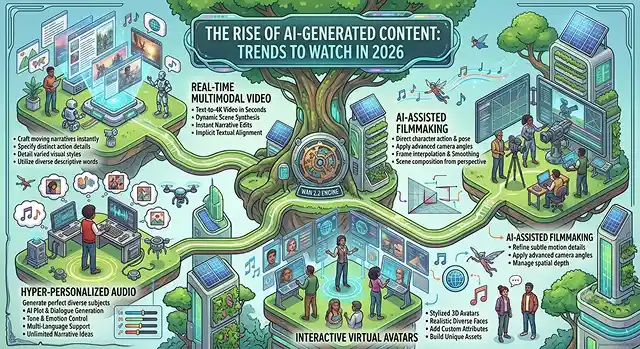
The advancement of Generative AI has brought the technology from basic text prompts and experimentations in image generation to becoming an essential part of many processes relating to media, software, and marketing. The global content landscape is changing from raw automation to more advanced workflows, formation of multimodal content, and the provision of authentic content by means of human involvement.
Main AI-generated content trends and the relevant strategies companies can use to meet the requirements of publishers such as Google AdSense have been summarized hereinafter.
Above-the-Fold Breakdown: Traditional Publishing vs. 2026 AI Workflows
Content Strategy Matrix · Traditional Production vs. AI-Assisted Pipeline
| Content Strategy Dimension | Traditional Content Production | 2026 AI-Assisted Workflow |
|---|---|---|
| Primary Discovery Channel | Traditional Search Engines (Google/Bing) | AI Search & Engine Citations (ChatGPT, Perplexity, Gemini) |
| Asset Creation Format | Single-medium creation (Text OR Image) | Native Multi-Modal Rendering (Text + Video + Audio + 3D) |
| Production Architecture | Manual execution with light software assistance | Autonomous Agentic AI Pipelines (Multi-step execution) |
| Content Personalization | Static cohort-based audience targeting | Real-Time Dynamic Hyper-Personalization |
| Quality Control Standard | Manual human review & copyediting | Hybrid Proofing (Fact-checking, EEAT, and watermark auditing) |
The Top 8 AI Content Trends
1. Agentic Workflows Replace Single-Prompt Generation
- The days of typing just one command and simply copying what AI produces are going behind us. Nowadays, people have adopted Agentic AI systems that are capable of developing plans, conducting research, creating content, verifying information, writing code, and optimizing media in a number of steps. Content creation processes have moved from prompt engineering to workflow architecture.
2. Multimodal Generation as the Default
- New-generation models can work with text, speech, images, and videos simultaneously. Creating a video script automatically creates matching visuals, synthetic voiceovers with micro-prosody, and sounds.
3. “Authenticity First” & The Battle Against Low-Quality Content
- Ever since the web is oversaturated with AI-generated texts and images, human experience (E-E-A-T) became one of the most important criteria for ranking website content. People and algorithms react negatively to generic AI content (“AI slop”). An efficient content strategy is a mix of the speed of artificially generated content and the insights, experience, and data provided by human authors.
4. Enterprise Generative Video Reaches Production Grade
- Multimodal video diffusion transformers (such as Sora, Google Veo, and Wan) produce cinematic 4K video with precise camera physics and spatial audio. AI video generation is now widely used for commercial B-roll, product advertisements, and localized film production.
5. Models Specifically Designed for Certain Domains and Designed for Local Data
- In place of using general LLMs, companies prefer to use small models which have been developed from proprietary data. Using quantized open weights locally means that the data remains private, the costs of the API are reduced, and there is a high accuracy in the specific domain.
6. Hyper-Personalization in Real-Time
- The systems which are used to create content create different versions of advertisements, videos, and web pages in accordance with the needs of users.
7. AI Voice Localizing and Multilingual Dubbing
- Our neural audio systems transliterate, re-voice, and lip-sync your video content in dozens of languages within minutes-retaining the unique characteristics, pitch, and cadences of the original speakers.
8. Stringent AI Regulation and Synthetic Watermarking
- It is essential for regulatory agencies and large digital platforms to require crypto-provenance, e.g. the implementation of C2PA standards. Search engines and advertising networks are now filtering all unlabeled deep-fakes and programmatically generated materials.
2026 Content Creation Landscape Matrix
Strategic Evolution · Legacy vs. Modern AI Production Frameworks
| Trend Dimension | Legacy Approach (Pre-2025) | Modern Approach (2026+) | Key Industry Driver |
|---|---|---|---|
| Workflow Engine | Manual text prompts & manual editing. | Autonomous multi-agent orchestration. | Efficiency & scalability. |
| Media Type | Text-only or isolated 2D images. | Native Multimodal (Video, Audio, 3D). | Unified DiT architectures. |
| Quality Filter | Mass keyword-stuffed publishing. | Human-in-the-loop editorial curation. | Search quality & E-E-A-T updates. |
| Localization | Text subtitles or robotic voiceovers. | Cross-language audio cloning & lip-sync. | Global distribution. |
| Infrastructure | High-cost cloud API calls. | Hybrid (Local open models + Cloud APIs). | Privacy & cost efficiency. |
Request A Custom AI Video
Tell us what you're trying to create and we'll point you to the right tool — or help you set it up.
Deep Dive: Agentic Multi-Node Architecture vs. Single LLM Inference
TThe biggest evolution in AI content is the move away from single-prompt generation ("Write a blog about X") to Multi-Agent Orchestration Systems.
┌──➔ [Agent 2: Fact-Check & Verification Node] │ [User Intent] ➔ [Agent 1: Orchestrator] ┼──➔ [Agent 3: Multi-Modal Asset Generator] ──➔ [Output Compiler] ➔ [Final Master Content] │ └──➔ [Agent 4: Compliance & Brand Guardrails]
Why Multi-Agent Systems Outperform Single Models:
- Self-Correction Loops: Instead of outputting the first draft, an Agentic Loop passes generated text to a specialized verification node that checks assertions against trusted, live databases before compiling the final draft.
- Context Window Efficiency: Passing one continuous $100\text{k}$ token prompt degrades model attention. In multi-agent systems, tasks can be divided into a variety of smaller components (researching, drafting, formatting, application of schema), while ensuring each node remains within its optimal context window.
- Deterministic Tool Usage: Orchestrator agents take advantage of protocols like the Model Context Protocol (MCP) and manage to run local Python scripts, query SQL databases, and directly utilize API calls, marrying the best of dynamic AI with fixed reliable data.
Synthetic Content Provenance & C2PA Cryptography
In response to regulatory demands for clearly sourced synthetic media, digital publishing platforms are beginning to employ C2PA (Coalition for Content Provenance and Authenticity) standards of cryptography in their operations.
Here's how C2PA Watermarking Works:
- JUMBF Metadata Injection: When an AI image or sound is created, a system embeds a JUMBF manifest into it, which cannot be tampered with afterward.
- Tamper-Proof Hashing: The manifest contains an unbroken hash code based on a secret key. It holds the information about the model that produced the video image, when it was executed, and who signed it.
- Browser Verification: The search engines implement their cryptography techniques to verify if the new technique allows synthetic media to be delivered seamlessly, without being detected.
Generative Engine Optimization (GEO) & Search Algorithms
Search engines now comprise more than just keyword matching systems. AI-powered search assistance requires the use of a set of strategies called Generative Engine Optimization (GEO).
- Entity-Density Optimization: The indexing process in search engines uses the identification of specific words, entities, and connections between them. Therefore, specific content must be created using only fixed phrases and accurate terminology instead of employing general words to fill it up.
- Direct Answer Block Architecture: Format key insights in short 2-to-3 sentence summaries placed directly beneath bold headers. Generative search bots pull these blocks first when compiling answers.
- Primary Experience Ingestion (E-E-A-T): AI systems filter out generic "re-phrased" summaries. Incorporating original datasets, primary interview quotes, custom code blocks, and real-world testing data ensures your content ranks as a primary source.
2026 AI Content Trends Primer
Explore the key developments in generative physics, multimodal synthesis, and legal compliance defining media pipelines this year.
The five major breakthroughs shaping 2026 include: 1. Physics-Grounded World Simulators (like Wan 2.2 and Sora 2 rendering realistic weight, gravity, and fluid motion), 2. Native Multimodal Audio-Visual Generation (models like Veo 3 outputting synced sound effects and dialogue alongside video), 3. Autonomous Agentic Content Pipelines (AI agents managing scripting, editing, and publishing end-to-end), 4. Real-Time Post-Production Relighting & Depth Mapping, and 5. Zero-Shot Cross-Lingual Vocal & Lip-Sync Localization.
Early generative models operated purely on surface pixel guessing, causing limbs to dissolve, shapes to morph, and objects to drift. Modern 2026 spatial transformers incorporate real-world vector mechanics and 3D geometry grids. Engines analyze physical forces like momentum, gravity, light refraction, and collision boundaries, ensuring that complex elements like shattering glass or flowing water maintain structural realism across scene cuts.
Instead of creators manually executing every single prompt and edit step, Agentic Workflows connect independent models together. An orchestrator agent can ingest a trending topic, draft a script, call voice synthesis engines, generate matching 9:16 or 16:9 video assets, apply auto-captions, and queue social media uploads automatically—shifting the creator's role from manual worker to creative director.
Rather than filming separate commercial campaigns for every country, brands generate a single master video asset and deploy neural localization suites. Cross-lingual voice synthesis translates dialogue into 40+ languages while preserving the original actor's voice quality, and real-time lip-sync models re-render facial movements frame-by-frame so the on-screen talent appears to speak every target language natively.
Global legal frameworks strictly dictate that unmodified, raw AI outputs cannot be copyrighted because they lack human authorship. To build a legally protected asset, creators must demonstrate substantial human creative input—such as human script direction, manual timeline composition, custom visual editing, or voice layering. Unedited machine outputs immediately fall into the public domain.
Major platforms (including YouTube, Meta, and Google) enforce strict C2PA cryptographic metadata standards to combat deepfakes. AI generators automatically embed tamper-evident digital provenance tags into output files detailing their synthetic origin. Social algorithms read these tags to display mandatory disclosure labels, ensuring transparency without hurting organic reach for compliant creators.
While closed cloud models (like Sora or Veo) offer impressive out-of-the-box convenience, open-source models grant creators complete technical freedom. Running models like Wan 2.2 on local desktop GPUs or private servers allows developer teams to train custom character LoRAs, build node-based ComfyUI automation workflows, and generate unlimited high-definition content without recurring subscription fees or cloud queues.
Rather than relying 100% on pure text-to-video, studios combine real-world filming with AI enhancements. Key elements—such as human face-to-face interviews, emotional acting, and core product shots—are filmed traditionally to preserve authentic human connection. AI generative models are then deployed for heavy B-roll environments, atmospheric VFX, automated audio cleaning, dynamic captions, and instant multi-format re-framing.
Media distribution is moving away from static, pre-rendered broadcasts toward Dynamic Content Rendering. Advanced marketing pipelines can now generate custom personalized video variations on the fly—adjusting background settings, language accents, or product colors in real time based on a viewer's regional location, device preferences, or browsing history.
Follow this 3-Step Future-Proofing Framework: First, master structured prompt engineering and reference-guided workflows (Image-to-Video) rather than depending on random text generations. Second, integrate automated AI localization and auto-framing tools to expand across multiple global feeds simultaneously. Third, maintain transparent compliance by tagging synthetic media appropriately and layering in distinct human editorial direction to build a strong brand identity.
Ready to try AI Videos?
Transform your ideas into cinematic video in seconds.