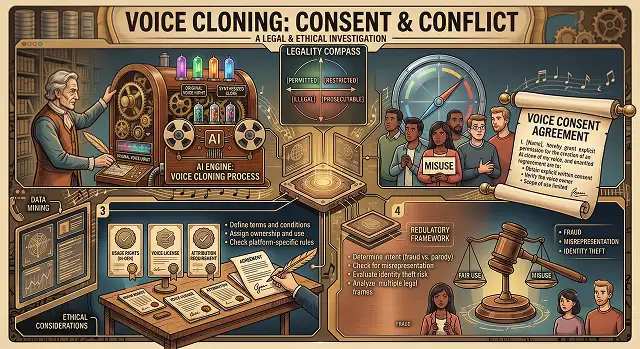
The rapid rise of generative AI voice technology has outpaced old law books. In 2026, the question of whether it is legal to clone a voice depends heavily on two critical words: Consent and Intent.
If you purchase a vocal profile from an artist using a reliable platform that is ethically licensed, you will have no problem. But in case you record a portion of somebody else’s audio recording without their authorization and use it to make a song or advertisement, you will land yourself in legal trouble.
The Core Verdict: When is Voice Cloning Legal vs. Illegal?
The law treats an individual's voice as a primary piece of their personal identity. As a result, the legal boundaries are split cleanly down the center:
1. What is Legally Compliant (Green Light)
- Cloning Your Own Voice: You hold the natural rights to your own vocal profile. It is legal to train custom models based on one’s own voice for automatic podcasting, video narrating, or text-to-speech applications.
- Explicitly Licensed Voice Models: Through ethical, licensed services/marketplaces, such as Kits AI or Voice-Swap, where actual humans vocalists are paid in kind via an agreed revenue split.
- Documented Commercial Contracts: Having a voice actor on staff and ensuring they execute a specific AI Voice Addendum with terms detailing scope of use, channels, length, and payment terms.
2. What Tends to Be Illegal (Red Light)
- Unauthorized Celebrity Soundalikes: Training an AI model on a popular singer’s or actor’s catalog to drop a viral track or voice an ad without their written sign-off.
- Deceptive Impersonation & Scams: Cloning the voice of a regular individual or public official to execute phishing schemes, distribute political disinformation, or defraud family members.
- Corporate Misappropriation: Continuing to use a former employee’s or contractor’s cloned voice for company training videos after their contract has ended without an explicit license.
4 Legal Pillars Protecting Human Voices
Due to the lack of a unified international law regulating AI-related issues, courts and governments apply several different legal doctrines to punish those who create unauthorized voice replicas:
1. Right of Publicity (Personality Rights)
- Voice, appearance, and name are private property. As per Right of Publicity doctrines, people own exclusive rights to use their identity for commercial purposes. The court decisions of such cases as the landmark victory of Bollywood singer Arijit Singh against websites that stole audio clips prove that replicating someone's voice without consent violates their personality rights.
2. Copyright Infringement
- For generating a highly accurate AI voice clone, hours of good quality pre-recorded audio clips need to be fed into the machine learning algorithm. However, in the event that the automated system uses those audio clips from the copyrighted songs, movies, and audio books for training purposes without a license to use that dataset, the copyright holder can sue for copyright infringement.
3. Trademark and Unfair Competition (Lanham Act)
- In case you use an audio deep fake that resembles the famous person very accurately to market the software products or services offered by your company, you may face violation of consumer protection laws. Even a small disclaimer text may not help if the voice is used for deceiving consumers about endorsement from a celebrity.
4. Wire Fraud and Criminal Law
- Using voice synthesis tools to manipulate or deceive someone out of money—such as pretending to be a relative in distress or an executive ordering a wire transfer—is aggressively prosecuted under existing anti-fraud, identity theft, and extortion criminal statutes.
Legality Framework: Quick-Reference Guide
Synthetic Media Compliance · Audio Risk Mitigation Matrix
| Legality Tier | Typical Context / Action | Legal Implications & Rules | Target Action Workflow |
|---|---|---|---|
| Fully Legal | Cloning your own voice for content pipelines (podcasts, text-to-speech scripts). | You hold the natural rights to your own vocal identity. Fully compliant. | None. Ensure proper API model access controls to prevent theft. |
| Fully Legal | Utilizing licensed marketplace models (e.g., Kits AI, Voice-Swap). | Contractual royalty structures protect you from claims. Artists are compensated fairly. | Verification. Keep license documentation safe and check active platform terms. |
| High Risk | Deploying voice actors without a dedicated synthetic media contract addendum. | Broad legacy employment contracts rarely cover machine learning training models. | Add an AI Voice Addendum. Define usage duration, distribution scope, and termination clauses. |
| Illegal | Creating unauthorized celebrity soundalikes for songs or ad copies. | Direct violation of the Right of Publicity and unfair commercial competition. | Stop. Source models from officially licensed libraries or secure explicit written corporate consent. |
| Criminal | Deceptive impersonation (phishing scams, deepfake financial wire commands). | Aggressively prosecuted under identity theft, fraud, and extortion criminal statutes. | Total Prohibition. Immediate platform account termination, auditing, and data erasure. |
Request A Custom AI Video
Tell us what you're trying to create and we'll point you to the right tool — or help you set it up.
The 2026 Legislative Landscape: The Laws are Cracking Down
Lawmakers are passing explicit, strict statutory boundaries specifically targeting synthetic audio generation:
- Tennessee’s ELVIS Act: Enacted as the Ensuring Likeness Voice and Image Security Act, this law makes a human voice a protected property right. It penalizes not only the bad actors creating unauthorized clones but also holds tech platforms civilly liable if they distribute cloning tools specifically designed to mimic human performers.
- The Federal NO FAKES Act: Crucial bipartisan federal legislation has advanced with unanimous support out of the Senate Judiciary Committee. The bill establishes a clear, nationwide federal intellectual property right covering an individual’s voice and visual likeness, backed by a DMCA-style rapid takedown system to quickly remove unauthorized deepfakes from the internet.
- Global Rules (India & Mexico): Landmark updates—like India’s Information Technology Amendment Rules and Mexico’s Federal Copyright Law reforms—enforce heavy daily fines and mandatory three-hour takedown windows for platforms hosting deceptive, non-consensual "Synthetically Generated Information" (SGI).
Compliance Framework: How to Safely Clone Voices
If you are a web developer, video creator, or marketing agency building custom media creation workflows, follow this strict operational pipeline to remain completely safe:
1. Secure Explicit Written Consent
- Never rely on general employment contracts or verbal approvals. Draft a standalone addendum that explicitly states the target speaker understands their voice is being utilized to train a generative AI model.
2. Define the Licensing Scope Matrix
- Explicitly document the exact bounds of the voice profile. Specify where the audio will be hosted (social media ads, YouTube videos), for how long the license for the file lasts (one year at most), and if the individual has the freedom to withdraw their permission at any time.
3. Implement Technical Safeguards
- When generating the audio master files, embed invisible digital watermarks or unique tracking metadata keys directly into the file layers. This acts as permanent proof that the audio came from an ethical, authorized workflow node.
4. Clear Labeling & Transparency
- In cases where the audio can potentially pass off as a real human voice in consumer domains, include transparent labels (audio or otherwise) stating that the audio was modified through AI technology.
AI Voice Cloning Legality
Navigate the legal frameworks of vocal identity rights, biometric consent, and copyright boundaries.
Absolutely **not**. Cloning a real person's voice without their explicit, documented permission introduces extreme legal vulnerability. While voice cloning software is legal to own, utilizing it to replicate an individual's vocal identity without consent crosses into identity theft, fraud, and violations of state right-of-publicity laws. If the clone is used in commercial advertisements, social campaigns, or public distributions, the target individual can sue for massive financial damages based on unauthorized commercial exploitation of their likeness.
The legal landscape has shifted heavily due to the NO FAKES Act (Nurture Originals, Foster Art, and Keep Entertainment Safe Act). This milestone legislation establishes a powerful federal intellectual property right, giving every single citizen—celebrity or private individual—absolute control over digital replicas of their voice and visual likeness. The law makes individuals and companies directly liable if they produce, host, or profit from an unauthorized digital voice clone, eliminating the previous patchwork of conflicting state rules.
Relying on implied consent or general terms-of-service checkboxes is a recipe for legal disaster. Legal voice replication requires a structured, written Voice Licensing Addendum. This document must explicitly record three main constraints: **Scope of Use** (detailing exactly which ad campaigns or channels the audio will live on), **Temporal Bounds** (stating exactly how long the files can be used), and a clear **Revocation Clause** outlining how the human voice owner can pull permission and force asset deletion later.
Global compliance standards have become incredibly strict. Under **India's IT Amendment Rules**, voice clones and deepfakes are classified under the technological umbrella of Synthetically Generated Information (SGI). The law introduces a brutal compliance timeline: if a platform hosts an unauthorized voice clone or deceptive deepfake used for impersonation, they are legally forced to take down the offending material **within 3 hours** of receiving a complaint or official government notice.
Yes, transparency is now a critical regulatory expectation globally. Major international frameworks and consumer protection bodies (like the FTC and MeitY) command visible or auditory labeling on synthetic media. For audio tracks, you must include a clear auditory disclosure statement or embed unalterable metadata tags identifying the content as synthetically generated. Major networks like YouTube, TikTok, and Meta will actively suspend or demonetize accounts that fail to declare synthetic tracking.
Yes, but modern laws provide a safe harbor if platforms act quickly. Borrowing from the DMCA copyright model, the NO FAKES Act sets up a streamlined Notice-and-Takedown procedure. Web services and social platforms are protected from direct financial liability *only* if they immediately block or take down an unauthorized digital voice clone the moment they gain knowledge of its unauthorized status. Users who submit false counter-notices face automated fines of up least $25,000.
Adhere strictly to this secure 3-Step Verification Pipeline: First, secure an explicit, wet-ink or verified digital signature contract outlining channel scope limits, regional distribution tags, and clear payment terms. Second, implement hard technical safeguards—such as rendering audio assets inside controlled enterprise platforms and embedding cryptographic metadata tracks to prevent downstream scraping. Finally, always activate explicit "AI Vocal Representation" disclosures across all public feeds to ensure absolute compliance boundaries.
Ready to try AI Videos?
Transform your ideas into cinematic video in seconds.