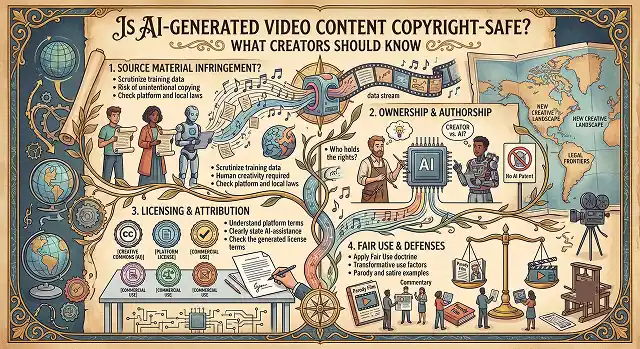
Last month a friend hit me up with genuine panic – one of the YouTube videos he’d created using an AI tool was rejected during his monetization review. “Wait, is it legal to use this?” he asked me. And honestly, that question comes up a lot more than people expect once they start actually publishing AI-made content instead of just playing around with it.
So let's actually get into it — not as legal advice (I'm not a lawyer, and neither is your AI tool's terms page, technically), but as a practical breakdown of what tends to matter.
The Core Principle: AI-Only Content Is Not Subject to Copyright Protection
Under U.S. copyright law, there must be human authorship. This does not happen for the first time with AI but was determined already in a 19th-century case about photography before the Supreme Court and has remained consistent since then. The development brought about by AI is that it forces the issue into sharper focus: If the video results only from a textual prompt without any further human creative input regarding how it looks, is there a human author at all?
The stance taken by the Copyright Office of the United States, supported by a March 2, 2026, Supreme Court decision (Thaler v. Perlmutter) not to review a challenge against it, is that the answer is negative: AI-only generated content cannot be copyrighted, not even by its creator or the creators of the software tool used.
Wait, So a Prompt Doesn't Count as Authorship?
This is where the confusion comes in. The natural feeling that giving a detailed prompt would be actual creative input seems logical. This is not the case according to the legal definition put forth by the Copyright Office. While a prompt gives instructions on what you are looking for, the AI will make the creative decisions on the details, movement, and visuals. Since those expressive decisions were made by the AI rather than by you, the Office's reasoning treats the prompt as closer to an idea than to the finished creative expression itself, and copyright doesn't protect ideas alone.
What does count as meaningful human authorship, based on how the Copyright Office has actually handled registrations so far:
- Substantial editing after generation — cutting, rearranging, combining AI output with your own footage, or modifying it in ways that go well beyond a color adjustment or a crop.
- Original arrangement of AI elements — compositing multiple AI-generated pieces into a sequence or structure that reflects your own creative choices, not just accepting the first full output.
- Combining AI material with human-made work — your own voiceover, your own filmed footage, your own script, layered with AI-assisted elements.
What generally hasn't been enough: running several prompts and picking your favorite result, or making only trivial changes like a crop or a filter after generation.
What Likely Counts as Protectable
Based on Current Copyright Office Registration Practice
| Scenario | Likely Outcome |
|---|---|
| Type a prompt, download the video as-is | Likely not protectable. Minimal human control over expressive detail. |
| Generate several options, pick your favorite | Likely not protectable. Selection alone hasn't been treated as sufficient authorship. |
| Heavily edit and rearrange AI output | Human-edited portions likely protectable. The AI-generated base material typically isn't. |
| Combine AI elements with your own filmed footage or voice | Your original contributions are likely protectable as your own work. |
| Only crop, color-correct, or lightly trim AI output | Likely not enough on its own to establish meaningful human authorship. |
Request A Custom AI Video
Tell us what you're trying to create and we'll point you to the right tool — or help you set it up.
Three Separate Issues Instead of One
This problem will be easier to handle if you don’t try to treat “is AI content safe from copyright” as one binary question because there are three issues involved.
1. Do you have any rights at all to what you've created? This was the human authorship issue discussed above. Just pure AI generated content without any significant human editing – most likely not eligible for copyright at all. Human editing or combining it with your original creation – the human-created elements are most likely copyrightable.
2. Can your AI output somehow unintentionally infringe copyright? This is a different matter. When a video created with AI turns out to resemble a certain existing character or artistic style or copyrighted work enough to raise an infringement claim against you despite that fact that you weren’t aware of such similarity. The danger is very real but unpredictable.
3. Can you sell or use AI content commercially at all? This is answered by the AI tool's terms of service, not by copyright law. Copyright status and commercial usage rights are genuinely different questions. You can often use and sell AI-generated content commercially if the platform's terms allow it, even in situations where the underlying content technically isn't copyrightable in the traditional sense. Read your specific tool's terms rather than assuming.
The Real Meaning of All This for Your Work Process
- Think of AI content as unprocessed content. Not an asset ready-to-use. The more you actually participate in creating the end product through editing, compiling, organizing, the more ownership you have on that part of work.
- Document everything along the way. Keep the prompts you use, drafts, and the process of editing that you do. In case of any dispute, showing your real contributions will matter.
- Avoid prompting for a specific artist's style or a copyrighted character. This raises the infringement risk in question two above, separate from the ownership question entirely, and it's one of the more avoidable risks in this whole space.
- Read the specific AI tool's terms of service. Commercial usage rights vary tool to tool and aren't determined by copyright law at all. Don't assume one platform's rules apply to another.
- This space is genuinely still moving. Aside from the ownership issue, there are also other ongoing issues regarding whether using copyrighted material in training an AI model can be deemed infringement, cases which will further alter some aspects of this landscape.
The safest creative choice isn't to avoid using AI altogether; it's to make sure that enough of your end product is definitely yours such that you don't even have to worry about ownership issues.
It’s worth pointing out how quickly the landscape keeps changing: at an earlier point in 2026, Disney negotiated a licensing agreement that allowed recognizable characters, such as Mickey Mouse, to be generated in a popular AI video generator, which shows that big license holders are actively figuring out business frameworks around this topic rather than just approaching it from a legal standpoint. Look for more agreements and decisions coming down the pike in the next couple of years.
This piece is informational in nature, not legal advice. Your copyright situation is very fact-specific based on your particular circumstances and laws in your jurisdiction are developing rapidly in this context. If there are actual dollars at stake or a potential dispute, consult with an experienced copyright lawyer.
AI Video Copyright & Legalities
Navigate the legal landscape of human authorship thresholds, public domain risks, and intellectual property compliance.
Under standard legal frameworks across major global jurisdictions, the short answer is **no**. Intellectual property offices explicitly dictate that copyright requires a human creator to qualify for protection. If a video asset is generated completely autonomously by typing a single phrase into a prompt field, the law views the machine as the executor of the expression. The raw output immediately falls into the public domain, meaning competitors can technically reuse it freely without your permission.
You must treat the AI engine as a supportive tool rather than the final director. To claim an enforceable right, protectability hinges on your substantial creative selection, arrangement, and post-production modification. Generating twenty separate clip modules, discarding fifteen, slicing the remaining five into a unique narrative sequence, layering in human voiceover commentary, and adding manual color grading maps out a distinct human contribution that you can legally claim.
The legal risk for the end-user is generally minimal, but a gray area persists if your generation directly mimics existing creative materials. If your prompt tells the engine to intentionally replicate a copyrighted character or copy a highly specific movie sequence frame-by-frame, you can be held liable for creating an unauthorized derivative work. To minimize risk, check your AI platform's terms of service for commercial indemnification coverage clauses.
The public domain trap occurs when a business builds an entire commercial product line, course package, or brand advertisement using unedited AI media blocks. Because raw machine exports carry no proprietary ownership weights, you have zero exclusive distribution rights. A competitor can download your video, drop it directly onto their own monetized website layout, and you will have no legal standing to issue a copyright takedown notice against them.
Yes, regulatory laws are tightening globally. Government rules (such as updated digital media compliance amendments and the European Union AI Act) require prominent disclosures on synthetically altered or generated video clips. Furthermore, social video platforms like YouTube and Meta enforce strict community guideline settings requiring you to toggle the "Altered Content" tag active if your video presents realistic scenes or voice clones generated by artificial tools.
This is a widespread industry myth. Purchasing a paid software license or commercial enterprise plan grants you a contractual license to utilize the platform's computing network without platform watermarks, but it cannot override statutory copyright law. A paid plan keeps you clear of violating the software vendor's terms, but the final output's legal protection still depends entirely on the extent of your human creative input.
Adhere strictly to this secure **3-Step Legal Workflow**: First, document your creation trail by saving separate files of your text script layouts, prompt variations, and raw machine output files as evidence of your workflow. Second, apply significant human layer styling—such as heavy manual editorial timeline sequences, custom color tweaks, and human voice tracks. Finally, explicitly file your registration claims detailing only the human-modified elements to secure an unshakeable copyright moat.
Ready to Create With Confidence?
Build video content where your creative fingerprint is unmistakably yours.