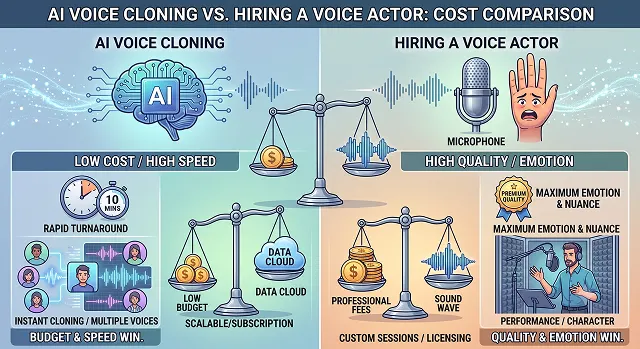
When you’re weighing whether to use AI voice cloning or hire a professional voice actor, it usually boils down to a classic showdown: budget and speed vs. quality and emotion.
Here is a realistic, human-friendly breakdown of how the costs compare, what you’re actually paying for, and how to choose the right path for your project.
What You're Actually Paying For
Voice actors don't really sell you "a voice." They sell you a finished, edited, studio-treated audio file, backed by a contract that spells out exactly where you're allowed to use it. That's why pricing gets complicated fast — you're not just paying for the minutes of talking, you're paying for equipment, editing time, retakes, and legal usage terms.
The AI voice-cloning process cuts nearly everything else out of the deal except for a line item in your monthly subscription plan. You're buying computing power and the right to deploy the result of the model's training. This is what it looks like in cold numbers:
- New voice actor freelancing: about $50 to $150 for one minute of audio completed, and almost everyone will have a minimum fee, no matter how short your script is.
- Experienced or union actor: $200 to $500+ per minute of audio completed when you add broadcast and exclusivity rights.
- AI voice cloning subscription: most tools sit in the $10–$30 a month range and let you generate tens of thousands of words within that.
- AI voice cloning, pay-per-use: often just a handful of cents for a full minute of speech once you're past whatever free allowance the platform gives you.
If price were the only factor, this article would be one paragraph long. It isn't, so let's get into the parts that actually change the decision.
The Variables Nobody Puts On The Price Sheet
Turnaround
Book a voice actor and you're waiting on their schedule — a session might not happen for a few days, and if a line needs re-recording, you're waiting again. AI cloning doesn't have a calendar. You type, it speaks, and if you don't like the delivery, you just run it again. For anyone working against a deadline, this alone can be worth more than the money saved.
Revisions
Most contracts include one or two rounds of changes before extra fees kick in. With AI, "revisions" aren't really a billable event — you can regenerate a sentence fifty times if you're being fussy about a single word's emphasis, and it costs you nothing beyond your own patience.
Usage rights
This one catches people off guard. A voice actor's rate for "web use only" is often a fraction of what they'd charge if that same ad later runs on television. Re-licensing an existing recording for a new use case can cost nearly as much as booking a brand-new session. AI subscriptions usually fold commercial usage into the plan, though it's worth reading the fine print — some free tiers restrict monetized use.
Scaling across languages
This is where the gap turns into a canyon. Need the same script narrated in five languages? With human talent, that's five separate bookings, five separate invoices, and five different voices that won't sound related to each other. Several AI cloning platforms can carry one cloned voice across multiple languages, so your English narrator and your Spanish narrator can, in theory, be the exact same "person."
Consistency over time
Record a voice actor in January and again in June, and you might notice the tone has shifted slightly — different mic, different mood, months apart. A cloned voice doesn't have off days. That's a genuine advantage for brands publishing content on a weekly schedule over a year or more.
What It Actually Costs, By Project
Real-World Scenarios · Rough Budget Numbers
| Project Type | What You'd Likely Pay |
|---|---|
| A single 60-second ad | A voice actor's flat fee usually lands between $75 and $200. Generating the same read with AI cloning barely registers against a monthly plan. For a one-off spot, though, a well-cast human voice can still pull its weight in memorability. |
| A 10-hour audiobook | Traditional narration at per-finished-hour rates can run $3,000 to $6,000 or more. The same length generated through AI cloning often costs under $50 on a subscription. Fiction listeners, though, tend to still prefer a human narrator's performance. |
| An eLearning course in 5 languages | Five separate voice actor bookings can easily add up to $1,500+ per language. One cloned voice, reused across languages, typically fits inside a single existing subscription — no extra booking required. |
| A weekly YouTube channel | Recurring voice actor fees quietly stack up across fifty-two weeks a year. A flat AI subscription doesn't care how many episodes you publish, which makes it the far cheaper option for high-frequency creators. |
| A flagship brand commercial | This is one of the few spots where the human voice actor still tends to win. The premium buys you a distinctive, ownable voice and clean union-backed usage terms — and for a campaign this size, that difference in cost is small next to what's at stake. |
Request A Custom AI Video
Tell us what you're trying to create and we'll point you to the right tool — or help you set it up.
A Quick Way To Do The Math Yourself
Instead of arguing in the abstract, run your own numbers through this:
- For a single project: compare the voice actor's flat fee against your AI subscription cost divided by however many projects you'll actually finish that month.
- For recurring content: multiply the voice actor's fee by the number of episodes or videos you'll need this year, and set that beside one flat annual AI subscription.
- For multilingual content: multiply the voice actor's fee by the number of languages required, then compare it to that same single AI subscription being reused across every language.
The pattern that keeps showing up: the more repetitive or high-volume your voice needs are, the faster AI cloning pays for itself. The more a project rides on one unforgettable, singular performance — a flagship campaign, the lead narrator of a beloved audiobook series, a brand's signature mascot voice — the more a real actor earns their premium.
This is not the issue of which is more affordable. This is the question of how often will I use this voice, and do I want it to be unequivocally human?
So, Which One Should You Actually Book?
- Voice cloning AI should be used if you publish regularly, if you have multiple languages, if you have a tight budget, or if you need quick drafts of your script to hear how it will sound.
- Hire a human voice actor if this is a lead campaign, if you want some real emotional depth of your character's voice, or if you plan to use this voice for many years as a trademark of your company.
- Or follow the silent practice of modern studios: use AI for drafts, internal discussions, and all versions of the script in other languages except English, but hire a human voice actor for your one "hero" version.
Voice Cost Comparison
A transparent financial breakdown between digital voice clones and human talent.
The entry barrier is completely different. A professional human voice actor typically charges between $50 to $250+ per finished minute or project milestones. On the other hand, premium AI voice cloning platforms operate on subscription models ranging from $5 to $50 per month, giving you access to thousands of generated words for the price of a few cups of coffee.
This is where traditional audio budgets often spiral out of control. If you tweak a single paragraph in a script after it’s recorded, a human voice actor will charge a re-recording fee and require a few days of turnaround time. With an AI voice clone, correcting a word or sentence costs absolutely nothing extra and updates within seconds on your dashboard.
Human voice talent often requires separate licensing or buyout fees depending on where the audio will live—such as local radio, national TV, or paid social media ads—and these licenses usually expire after a year or two. With AI platforms, as long as you are on a paid commercial tier, the audio assets you generate belong to you completely with no expiration date or platform restrictions.
Human talent is an investment in premium branding. If you are building a high-profile television commercial, an emotional documentary, or a flagship video game character, paying for a human actor is absolutely worth it. The nuanced emotional choices, acting delivery, and brand prestige a human brings can elevate an expensive asset far better than raw software.
Hiring voice talent sometimes incurs hidden operational costs, such as booking studio space, paying an audio engineer, or investing in mixing software to clean up room echo. AI voice cloning eliminates this entire structural layer. The output is delivered as a perfectly clean, mastered, and compressed digital file ready for immediate use.
If you want to translate a course or video series into five languages traditionally, you have to hire five different voice actors, multiplying your costs by 5x. With multilingual AI voice engines, your original custom voice clone can speak dozens of alternative languages fluently under your single existing platform subscription.
Many smart production houses now use a Legitimate Voice Licensing workflow. They pay a professional voice actor a lump sum up front to legally clone their voice with explicit contract consent. The company then uses the AI clone to rapidly scale out hundreds of simple daily tutorials, while hiring the physical actor back for premium main-stage media campaigns.
Ready to Try AI Voice Cloning?
Generate a natural-sounding voiceover in minutes, at a fraction of studio cost.