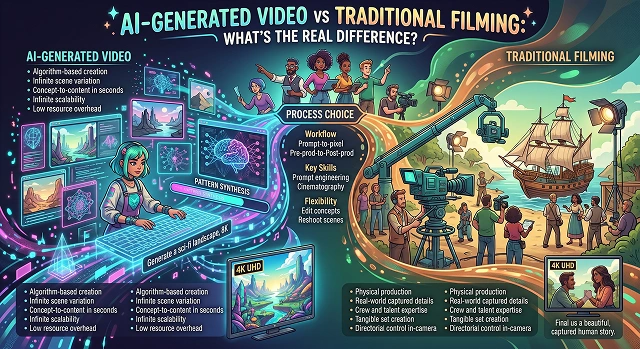
Video production has effectively split into two different disciplines now. It's not just a question of which camera or editing software you use — it's a choice between two completely different ways of making a video exist: shooting something real, or having a model compute it.
Traditional filming still runs on the old constraints: locations, lighting, schedules, actors. AI-generated video runs on something else entirely — diffusion transformer models rendering on cloud GPUs, with no set, no crew, and no weather to work around.
1. The Operational Split: Pixels vs. Practical Logistics
To understand why the output looks and feels different, you have to look at the foundational architecture of how each video is made:
[Traditional Pipeline] ➔ Pre-Production ➔ The Physical Shoot ➔ Post-Production (Linear & Rigid)
Text Prompt Token Injection ➔ Latent Space Denoising ➔ Render Master (Iterative & Modular)
The Traditional Filming Pipeline
- Traditional production relies entirely on capturing physical light waves bouncing off real objects. This pipeline is strictly linear and inflexible: planning the concepts, scouting the locations, recruiting the actors, organizing the crew for filming, and then cutting the files into the timelines manually.
- As it captures the real human emotion and natural texture, it gives the real look that still remains the gold standard of storytelling.
The AI-Generated Video Pipeline
- AI video platforms bypass the camera completely. When you input a text prompt or a baseline image, a text encoder converts your words into structural vectors. The machine learning network takes a canvas of pure random noise and mathematically structures it into organized pixel arrays frame-by-frame.
- There are no location permits, weather delays, or casting requirements—everything is built out of data strings.
2. The Creative Trade-off: Consistency vs. Scale
Choosing between these methods forces you to balance creative flexibility against absolute control over your visual identity.
Why Traditional Filming Keeps the Crown for Human Drama
- AI systems struggle with deep, authentic human emotion and intricate joint movement. The physical camera setup is still necessary for premium ads, human-oriented brand tracking, documentation of live events, and genuine testimonials.
- If one needs to create an instant emotional connection with an actual person, the physical camera cannot be substituted.
Where AI Video Dominates for Growth and Reach
AI is transformative where volume, customization, and speed of translation are concerned.
- Hyper-customization: Ordinary filming cannot affordably create individualized videos for a large number of customers. AI video software can easily connect to arrays of databases and generate individualized video content for hyper-targeting customers.
- Instant localization: Ordinarily, having your ad translated into 20 languages meant contracting 20 different local voice artists and spending several weeks in the recording studio. With AI video software, all that is required is to feed translation structures and leave the software to do the rest.
3. The Modern Strategy for Success: The Hybrid Formula
Today’s top-notch media production agencies and software companies do not view this dilemma as a win-or-lose proposition. On the contrary, they implement a Hybrid Production Model, which combines the efficiency of AI and the emotional impact of live shooting:
1. Capture the Human Anchor Core
- Shoot your primary brand assets, central product close-ups, or face-of-the-brand character testimonials using real, high-fidelity cameras on set. This process locks down your core brand identity and guarantees absolute physical consistency where it matters most.
2. Synthesize Background Environments
- Instead of building expensive real-world physical sets or spending money traveling to remote locations, use generative AI video engines (like Luma, Runway, or Wan) to render cinematic background environments and expansive B-roll clips.
3. Layer Complex Visual Effects
- Bring your combined live-action and generated assets into your video suite. Use AI motion brush masks to easily paint and adjust localized visual details—like adding cinematic weather conditions or changing clothes colors—without needing manual frame-by-frame rotoscoping.
4. Automated High-Volume Output Scaling
- Pass your finalized, clean master clips into automated rendering pipelines. Use task-specific AI layers to instantly crop, localize, and slice your horizontal 16:9 master files into hundreds of targeted vertical 9:16 short variations optimized for diverse social discovery feeds.
Hard Production Metrics Side-by-Side
Production Economics · Generative Frameworks vs. Traditional Filming
| Factor | AI-Generated Video | Traditional Filming |
|---|---|---|
| Financial Cost | Ultra-Low. Fixed cloud software subscriptions ranging from $10 to $200 per month. | High. Front-heavy budgets covering day-rates, gear rentals, and insurance. |
| Turnaround Speed | Minutes. Scripts or prompts turn into finished video clips in real time. | Weeks. Bound by calendars, shipping schedules, and manual post-production. |
| Revision Cycles | Instant. Typos or visual script changes are fixed by tweaking text tokens. | Destructive. Adjustments require booking expensive physical reshoots. |
| Creative Control | Guided Influence. The director steers the scene via prompt strings and mask matrices. | Absolute Command. Frame-level, physical control over every light and object on set. |
| Asset Consistency | Variable. Prone to minor texture shifts or facial morphing across shots. | Flawless. The exact same human and product design are captured every take. |
Request A Custom AI Video
Tell us what you're trying to create and we'll point you to the right tool — or help you set it up.
1. Under the Hood: The Spatial-Temporal Architecture Split
The real difference between these two production methods lies in how data is processed: traditional cameras convert real light into arrays of color values, while AI video engines manipulate variables within a mathematical latent workspace.
The Traditional Filming Pipeline (Hardware Capture)
Traditional cameras capture actual photons passing through glass lenses onto a physical sensor array (like a CMOS chip).
- [Photons Passing Glass Lens] ➔ [CMOS Sensor Ingestion] ➔ [Debayering Matrix Math] ➔ [12-Bit RAW Container]
- The camera's internal processing chips execute Debayering Matrix Algorithms in real time to translate raw electrical values into structured RGB pixel arrays. Such data is kept within a compressed container file format (like Apple ProRes RAW or REDCODE RAW).
- As the pixels map the real-life objects, such data naturally features perfect geometric consistency, realistic lighting changes, and correct human micro-expressions.
The Generative AI Pipeline (Latent Denoising)
AI video platforms bypass physical sensors entirely. When you feed a prompt or an anchor image into a modern Diffusion Transformer (DiT) model family (like Wan 2.2 or Luma Ray), the workspace shifts into an abstract mathematical space called the Latent Denoising Window.
- [Text Token Injection] ➔ [uMT5-XXL Matrix Processing] ➔ [3D Causal VAE Patching] ➔ [Computed Video Output]
- A text encoder (like uMT5-XXL) breaks down your prompt text into distinct mathematical features. The model initiates a canvas of pure random noise and partitions it into small spatial blocks called patches.
- Over 25 to 50 computation steps, the transformer's internal attention mechanisms use the text traits to reshape the random noise into organized pixel shapes. Because the network calculates time and spatial layouts simultaneously through a 3D Causal VAE, it can invent complex visuals out of thin air. However, because it lacks real-world physical boundaries, it remains prone to minor texture drifting and edge deconstructions across the timeline.
2. High-Performance Local ComfyUI Integration Layout
If you want to run an open-weight generative video pipeline locally without subscription paywalls, third-party watermarks, or data privacy risks, you can deploy the open-source Wan 2.2 model stack.
Configure this strict structural node network configuration inside ComfyUI:
1. Model Layer Ingestion
- Deploy the central UNETLoader node mapped directly to your local weights (e.g., wan2.2_t2v_14B_fp8.safetensors). Connect the CLIPLoader running the repackaged uMT5-XXL text processor along with a dedicated VAELoader directed to the native VAE model path.
2. Modality Routing Strategy
- For T2V workflows: Route an EmptyWanLatentVideo block directly into your sampler input.
- For I2V workflows: Add a Load Image node, scale your source photo to a clean 16:9 canvas size (1024 x 576), and pipe the pixels into a WanVAEEncode node to map the initial structural constraints.
3. Fine-Tune Sampler Parameter Weights
- Connect your processing paths to the unified KSampler node. To generate smooth cinematic motion, dial your parameters to: Steps: 25, CFG Scale: 5.5, Sampler: uni_pc, and Scheduler: simple. Paste this string into your negative text node: "warping backgrounds, digital artifacts, sudden cuts, flickering lights, low-res geometry".
4. 3D Causal VAE Decoding & Video Mastering
- Pass the computed latent blocks through the specialized WanVAEDecode node. The causal autoencoder translates the abstract mathematical values back into standard RGB frames, outputting a clean, unwatermarked WebM master file at 24 FPS.
AI vs Traditional Production
Compare budget scaling, project turnaround times, asset consistency, and localization pipelines.
It comes down to **logistics versus compute**. Traditional filming captures reality using physical hardware—requiring on-set cameras, lighting arrays, physical locations, and real actors. AI video generation completely bypasses the real world by synthesizing imagery out of data blocks using text or image prompts. Traditional excels at raw human authenticity and subtle micro-expressions, while AI rules when creating fantastical scenes or scaling visual concepts without physical limitations.
Traditional production involves heavy, fixed baseline costs (crew day-rates, gear rentals, catering, permits) that stay high regardless of video length. A baseline 2-minute brand video shot traditionally often runs thousands of dollars. AI video collapses these items down to software subscriptions and cloud compute tokens, often driving cost reductions between 60% and 90%. More importantly, multiplying variants with AI scales costs sublinearly, making extensive content iteration affordable.
Traditional filming is heavily bound by calendar schedules and linear planning. Pre-production, location coordination, multi-day shoots, and manual post-production typically take anywhere from 3 to 8 weeks to deliver a polished brand asset. AI video tools compress this pipeline down to hours or days. Because the software renders clips in minutes out of a written script, a creative director can script, produce, and finalize high-quality promotional edits in a single afternoon.
Traditional production wins here on absolute precision. What you capture on a physical set remains structurally locked—the actor's outfit, product geometry, and corporate logos look identical in every single take. Maintaining consistency across multiple generative clips is one of AI's toughest hurdles. Even with modern character-reference tools, minor visual drift can happen—like a logo subtly warping or facial features shifting between scene generations.
In traditional production, fixing a script error or altering a scene layout after wrapping the shoot means coordinating expensive reshoots that can devour up to 30-50% of your initial budget. With an AI pipeline, revisions are natively integrated into the workflow. Changing a character's dialogue, adjusting ambient lighting parameters, or modifying a background landscape simply requires tweaking text prompt arrays and regenerating the file in seconds.
AI video provides an unshakeable advantage when it comes to distribution scale. Splitting a traditional horizontal video into 15 vertical variations for targeted A/B tests requires a lot of manual timeline cropping and editor hours. Swapping languages often means hiring new voice actors and doing expensive re-edits. AI handles these variations natively. Automated localization engines can translate on-screen text, swap audio tracks, and change canvas aspect ratios effortlessly.
Adhere strictly to this proven 3-Step Hybrid Production Routine: First, shoot your core, brand-critical elements—such as client testimonials, face-to-face interviews, and complex product interaction shots—traditionally to preserve absolute human authenticity. Second, use neural generative engines to build immersive background environments, atmospheric effects, and rich filler B-roll without booking extra shoot days. Finally, run your mixed assets through automated clipping tools to format and scale your social media variants cleanly.
Ready to try AI Videos?
Transform your ideas into cinematic video in seconds.