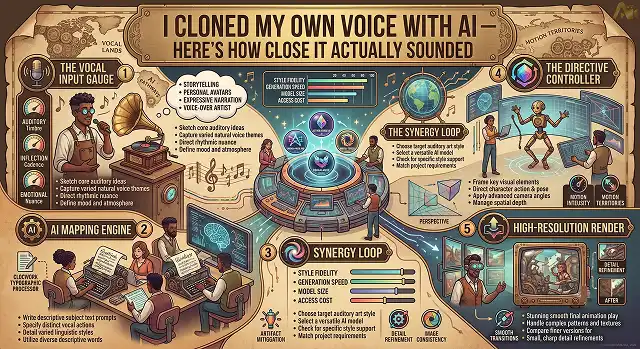
I wanted to know if AI voice cloning was actually good enough to fool someone who knows my voice well — not a stranger, someone who's heard me talk every day for years. So I recorded three different sample lengths of my own voice, cloned each one, and played the results for my family without telling them which clips were real.
This isn't a tool ranking. It's one person's voice, three sample lengths, and an honest account of what came out and who could tell the difference.
The Test
| Sample Length | Recording Condition | Family Guessed Correctly? |
|---|---|---|
| 15 seconds | Phone mic, quiet room | 3 of 3 — sounded slightly robotic on longer words |
| 45 seconds | Phone mic, quiet room | 2 of 3 — one person wasn't sure |
| 2 minutes | Laptop mic, reading a paragraph aloud | 1 of 3 — hardest to tell, closest match |
What Gave It Away
- Short samples (15 sec) nailed my general pitch and tone but got noticeably flatter and more even-paced than I actually talk — I trail off and speed up mid-sentence more than the clone did.
- Laughter and quick reactions were the single biggest tell across every sample length. Reading a scripted sentence sounded convincing; anything that needed a natural laugh or "hm" sound broke the illusion immediately.
- The 2-minute sample was the only one that captured the small pauses and breath sounds I actually make between sentences — which is exactly what made it the hardest for my family to call out.
What I'd Do Differently
If accuracy matters more than speed, a 2-minute sample recorded on a decent mic while just talking naturally (not reading stiffly) beat the shorter samples by a clear margin. For quick throwaway use — a voiceover line here or there — the 15-second sample was good enough that no one questioned it out of context, they only doubted it side-by-side with my real voice.
Request A Custom AI Video
Tell us what you're trying to create and we'll point you to the right tool — or help you set it up.